Blog · kundli basics
How to read kundli: a step-by-step guide for beginners
How to read a kundli chart in seven steps: the chart style, the Lagna, the houses, the planets, the house lords, the aspects and the dasha.
In short
To read a kundli, start from the Lagna (the 1st house), count the 12 houses from it, note which planets sit in each house, name each house's lord and see where it sits, then check the running dasha. The houses say what area of life is meant; the planets and lords say how it fares; the dasha says when.
How do you read a kundli chart, step by step?
-
1
Step 1: Know which chart style you are looking at
A North Indian chart keeps the houses fixed: the top centre diamond is always the 1st house and the numbers in it are signs (1 = Aries ... 12 = Pisces). A South Indian chart keeps the signs fixed in a ring of boxes and marks the Lagna. The reading is the same.
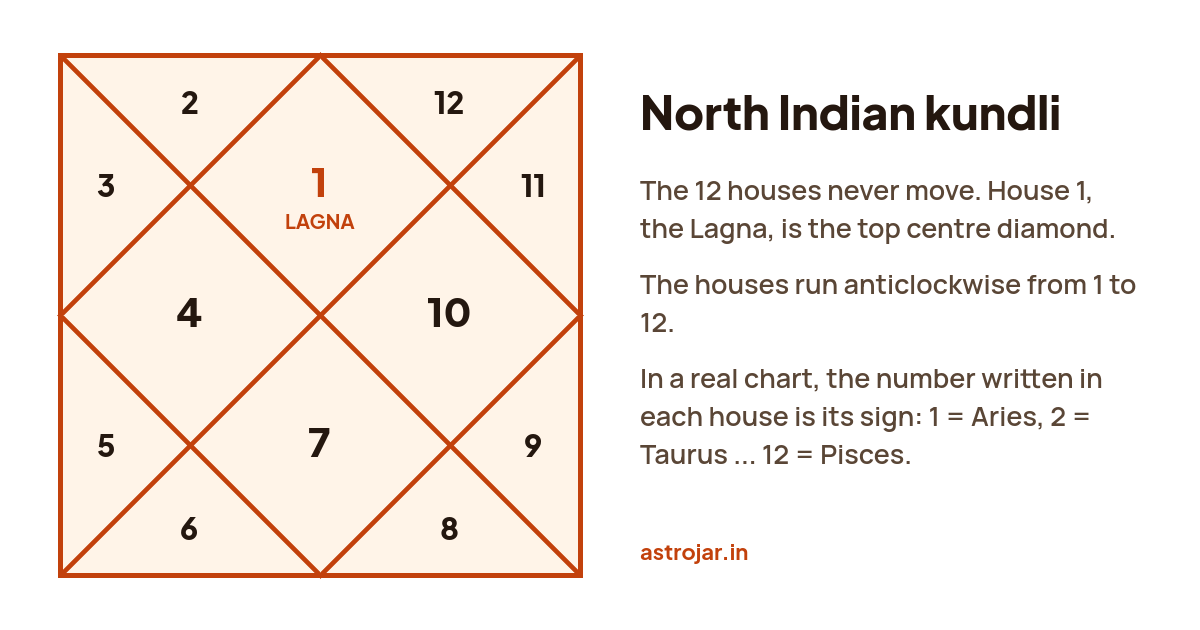
A North Indian kundli: the houses never move; the number written in each house is its sign. -
2
Step 2: Find the Lagna (ascendant)
The Lagna is the sign rising in the east at birth. It is your 1st house, and it sets every other house. Its lord, the Lagna lord, is the key planet of the chart (BPHS ch. 34 sl. 2-7).
-
3
Step 3: Count the 12 houses
From the Lagna, count the signs in order: the next sign is the 2nd house, and so on to the 12th. Each house covers areas of life: the 2nd wealth and family, the 7th marriage, the 10th profession (BPHS ch. 11).
-
4
Step 4: Note where each planet sits
A kundli shows nine planets: Sun, Moon, Mars, Mercury, Jupiter, Venus, Saturn, Rahu and Ketu, often shortened (Su, Mo, Ma, Me, Ju, Ve, Sa, Ra, Ke). A planet colours the house it occupies. Jupiter and Venus are the natural benefics; the Sun, Saturn and Mars the natural malefics (BPHS ch. 34 sl. 8-10). Rahu and Ketu are not physical bodies: they are the Moon's ascending and descending nodes (BPHS ch. 3 sl. 11), often called shadow planets.
-
5
Step 5: Name the lord of each house
Each house's lord is the planet that owns its sign: Mars for Aries, Venus for Taurus, and so on. Where a lord sits says how its house fares: in an angle or a trine it helps; in the 6th, 8th or 12th it weakens (BPHS ch. 12 sl. 1-2, ch. 13 sl. 1-2).
-
6
Step 6: Check the aspects
Every planet aspects the 7th house from itself fully. Mars also aspects the 4th and 8th, Jupiter the 5th and 9th, Saturn the 3rd and 10th (BPHS ch. 26 sl. 2-5). A benefic's aspect protects a house.
-
7
Step 7: Read the timing: dasha and transits
A kundli is timed with the Vimshottari dasha, a 120-year cycle of planetary periods that starts from the Moon's nakshatra at birth. The running period's planet brings forward the houses it owns and occupies. Transits of Saturn and Jupiter add the year-by-year picture.
What does a worked example look like?
One house read the classical way: the 7th house (marriage and partners) for a Leo Lagna.
- Find the 7th house With a Leo Lagna, count on from Leo: Virgo is the 2nd house, Libra the 3rd, and Aquarius the 7th.
- Name its lord Aquarius belongs to Saturn, so Saturn is the 7th lord (BPHS ch. 3 sl. 51-54).
- See where the lord sits Say Saturn is in Taurus. Counted from Leo, Taurus is the 10th house. BPHS says a house does well when its lord is in the 10th (ch. 11 sl. 14-16).
- Check the lord's aspect Saturn also aspects the 10th sign from itself (ch. 26 sl. 2-5). From Taurus that is Aquarius, so Saturn looks at its own 7th house. BPHS lists a house not aspected by its lord among the weakening factors (ch. 11 sl. 14-16), so this helps.
- Read it together The traditional reading: in this chart the 7th house, marriage and partners, is supported by its lord. It is one factor: the planets in the 7th and the running dasha still decide how and when it shows.
What do the numbers and letters in a kundli mean?
The numbers are signs
| Number in the chart | Sign (lord) |
|---|---|
| 1 | Aries (Mars) |
| 2 | Taurus (Venus) |
| 3 | Gemini (Mercury) |
| 4 | Cancer (Moon) |
| 5 | Leo (Sun) |
| 6 | Virgo (Mercury) |
| 7 | Libra (Venus) |
| 8 | Scorpio (Mars) |
| 9 | Sagittarius (Jupiter) |
| 10 | Capricorn (Saturn) |
| 11 | Aquarius (Saturn) |
| 12 | Pisces (Jupiter) |
The letters are planets
| Short form | Planet | Owns |
|---|---|---|
| Su | Sun | Leo |
| Mo | Moon | Cancer |
| Ma | Mars | Aries, Scorpio |
| Me | Mercury | Gemini, Virgo |
| Ju | Jupiter | Sagittarius, Pisces |
| Ve | Venus | Taurus, Libra |
| Sa | Saturn | Capricorn, Aquarius |
| Ra | Rahu | No sign |
| Ke | Ketu | No sign |
Sign lords: BPHS ch. 3 sl. 51-54. Rahu and Ketu own no sign in this scheme.
How do you read the kundli houses?
A house prospers when a benefic sits in it or aspects it and its lord is strong; it suffers when its lord is weak or joined by malefics (BPHS ch. 11 sl. 14-16). Learn what each house shows in the 12 houses in astrology and their lords, or go deeper with the lord of the 1st house, the 2nd house lord in astrology, what the 3rd house in astrology represents and the 7th house lord name for every Lagna.
What mistakes do beginners make?
Judging from one planet
One placement never decides a chart: weigh the house, its lord, aspects and the dasha together.
Mixing up chart styles
In a North Indian chart the numbers are signs, not houses.
Ignoring the birth time
A few minutes can change the Lagna, and with it every house.
Reading Western sign columns
Vedic charts use the sidereal zodiac, so most planets sit about one sign earlier than in a Western chart.
Questions about reading a kundli
How do I read my kundli for the first time?
Find the Lagna (marked in the chart), count the 12 houses from it, note which planets sit in which house, name each house's lord, then check the dasha you are running. Those five steps give the basic reading.
How do I read kundli houses?
Each house is a part of life: the 1st the self, the 7th marriage, the 10th work. A house is judged by the planets in it, the planets aspecting it and where its lord sits (BPHS ch. 11 sl. 14-16). See the 12 houses and their lords.
What is the difference between North and South Indian charts?
Only the drawing. In the North Indian chart the houses stay fixed and the sign numbers move; the top diamond is always the 1st house. In the South Indian chart the signs stay fixed and the Lagna is marked. The planets and the reading are the same.
Which is more important, the Lagna or the Moon sign?
Both are used. The Lagna sets the houses; the Moon sets the nakshatra, the dasha and many transit readings. BPHS says house rules can also be applied from the Moon (ch. 12 sl. 11).
Can I read my kundli without the birth time?
Partly. The planets' signs and the Moon's nakshatra are usually right, but the Lagna and the houses need the time. Without it, read the chart from the Moon.
Can a kundli predict exact dates?
A kundli shows periods (dashas) and transits when events are more likely, by traditional rules. Astrojar tests its timing rules against real, dated life events, keeps only what measurably helps, and its answers say how sure they are: see how Astrojar reads a chart.
Sources
- BPHS ch. 11 sl. 2-16 (houses).
- BPHS ch. 3 sl. 51-54 (sign lords).
- BPHS ch. 12 sl. 1-2, 11 and ch. 13 sl. 1-2 (lords in good and difficult houses).
- BPHS ch. 26 sl. 2-5 (aspects).
- BPHS ch. 34 sl. 2-10 (Lagna lord; benefics and malefics).
- Chapter and verse numbers follow R. Santhanam's English translation of BPHS (Ranjan Publications).About the text.
This is the traditional reading of the classical texts, given for learning and reflection. It is not a prediction for you, and not medical, legal or financial advice.
Read your own kundli with Astrojar
Ask Astrojar on WhatsApp: your first 3 questions are free. Or get a full report made from your birth chart.